
Secret books and a Tibetan monastery: Daniel P Brown´s tightrope walk between tradition and modernity
Updated: Jul 30

TL; DR: Dan Brown and Geshe Sonam Gurung spent 8 years translating secret Tibetan Bon texts into English. It was kind of Arche Noah for a dying tradition. Then they disagreed over a monastery. Dan wanted a modernist American design that would "dissolve into the mountains." The Tibetans wanted ochre walls and golden finials that announce a sacred place. The Europeans on the board dissolved themselves rather than approve it. The foundation split, the monastery got built without Dan, and Phase 1 opened in 2024. Dan felt abandoned. The Geshe moved on. Two strong-willed men with twenty years of closeness and a real rupture. Neither was wrong, exactly, just no longer pointing in the same direction. The translations survive on Amazon. Scholars criticise the language, but wouldn't have been able and motivated to read eight volumes in any other version.
A letter from Daniel P Brown
One day in 2021, I received a letter by the Pointing Out the Great Way Foundation. In this, the late Daniel P Brown (*2022) told his side of his long-standing conflict with the Mustang Bon Foundation. The Mustang Bon Foundation was the successor to his own Pointing Out the Great Way foundation, having split from it in a conflictual way.
The letter was touching. He spoke about his deep disappointment at not having been contacted by the Foundation, and in particular of his long time friend and collaborator Geshe Sonam Gurung, the leading Tibetan head of the new foundation, since Dan´s outbreak of Parkinson. He contrasted his felt human negligence with his own recent fundraising efforts for the foundation, despite Parkinson's .
With this, he implicitly referred to a 2019 "The trip of a lifetime" retreat with very wealthy donors to Tibet, as a result of which he collected 700.000 USD for the foundation. And he questioned why he did not get any accounting for this money, why he and was not even mentioned. The trip had been organised by "MindOnly", a short lived collaboration between Daniel P Brown and a former student of him, Jock Gordon. The following text is by Jock Gordon.
In 2019, Jock (Gordon) launched MindOnly, which integrates the best of Western psychology with Eastern contemplative traditions. MindOnly offers premium online courses, retreats and master classes from a seasoned faculty and other leading experts to improve mental wellness on a global scale. As a tribute to the businesses’s dedication to social impact, MindOnly launched The Trip of a Lifetime, which raised $700,000 USD for the Mustang Bon Foundation
Daniel P Brown´s rupture
But Dan´s main grievance was not the money. Instead, he disagreed with the direction of the Foundation for the design of the new monastery. Therefore, he suggested to the donors (I was one, albeit a small one) to review their commitment for further funding.
As a result, I initiated communication with the Foundation and a few days later received a personal phone call by Geshe Sonam Gurung. Here he is in an interesting video on dark room meditation.
Surprisingly, the Geshe gave me a personal and emotional background view.
I am not going into the details or taking a side. I don´t know enough. But my impression was that two saddened men had not managed to repair a rupture despite lasting affection and longing for each other.
I can share that - whatever actually may have happened - the Geshe at no moment spoke without compassion for Dan. I came out of the call with the impression of two strong-willed men, both with a vision that had diverged despite 20 years of closest collaboration on a different project: translating secret Tibetan texts to modernised English to make them comprehensible.
Books and a building: two different collaborations
They had started many years ago, at the request of Menri Trizin III, to translate these books. The mandate was to preserve the content, in view of the dwindling number of Tibetan tradition holders - a "project Arche Noah" for a dying local tradition, the Bon version of Buddhism.
In this project, Dan Brown and the Geshe collaborated until the project was finished.
But 7 years after starting the translations, a conflict over the architectural design for the new monastery affected their relation. Dan´s preferred design idea was simply "too modern" for the Tibetans and the foundation´s board, and also it was too ambitious and expensive. Today (May 2026), the foundation is urgently asking for funding so the foundation may have had good financial reasons.
The reason for the rupture: the architecture of the monastery
Note: this chapter was supported by NotebookLM research about the foundation history, and AI input for the architectural principles for which I am not an expert.
Dan Brown had originally worked together with a US architecture office, owned by a former student of him, Carl Maxey.
In 2017 the had presented a proposal for a monastery in Jomsom, Nepal. The design was modernist: cream-colored split-stone facades following the geometry of the surrounding cliffs, narrow vertical slit windows cutting light into shadow, interiors of clean geometry that dissolve into the mountain landscape rather than rise above it.

The projected cost was $13–15 million, to be built on government-owned land. It was a place of practice shaped by contemporary architectural thinking: restrained, considered, and in a Western way taking account of the terrain. The architetural renderings remain on Maxey's website as of May 2026 (scroll down).
But the costs were crushing: In a scrubbed interview from 2016 on Vimeo with Karen Case, then President of the POGW Board Dan Brown and Geshe Sonam Gurung, the plans are described.
Initially it was intended as a small monastery in classical wood/mud construction. Then it expanded into a steel reinforced building. Dan in the interview:
We had looked into building it in traditional wood and the mortars from the different clays and muds that are available in that area. But since the earthquake occurred, we don't think it's fair to have donors put money into a project and have the whole thing fall down with an earthquake. This is not in the epicenter area.
But we thought that if we built it in steel, then it would, and according to specifications that we know about earthquake building in the West, then it would last not 60 or 70 years like mortar and wood, but it would last at least 200 years. So we have something, we're building something that's ..indestructible this time.
And that's another big factor in terms of the price.The steel reinforcement, construction. And the third one was part of the original vision of the project was misinformed because it was based on our own other experience was building a philosophy school in Sichuan, China for Rahob Rinpoche. And this is building in Nepal rather than China is a much different issue because the building supplies are much more expensive than certainly in China.
And shipping everything to the mountains is very, very creative. It takes much more, it's much more expensive to build. We have to cut all the steel in advance. There's no welders that are going to go up there and do this. There's no cranes that are going to put it up. Everything has to be carefully planned.
The European board of the foundation refused to approve the concept. When Brown insisted on moving forward with Maxey and the design, the European board dissolved itself. The US board restructured and in 2019, proposed an alternate plan in direct disagreement with Brown's.
The Mustang Bon Foundation held to a different understanding of what a monastery is for.
In the Himalayan tradition, a sacred building is not the background. It is a proclamation. The deep ochre walls, historically reserved for high-status religious structures, announce the nature of the place before a teaching is given. Golden finials and victory banners mark the roofline against the sky. Painted pillars and ceiling mandalas turn every surface into an object of contemplation. The building participates in the practice.

The eventual decision was made, characteristically, through traditional means, as described on the foundation´s website. Geshe Sonam and the monastic community performed a "divination".
One could say that divine luck, perhaps to be expected, was with the new foundation. The result favoured a phased approach, drawing on local architects and local labour. This was a model rooted in community integration rather than in a design imported from the US .
The foundation hired MAP Design, an international architecture firm, to work alongside local Nepalese project management and site engineering.
MAP's plan, rooted in religious planning principles, organises the campus around 14 interconnected courtyards of varying sizes, on a cliff facing the Kali Gandaki River. This river has been the economic and cultural lifeline of the Mustang valley for centuries.
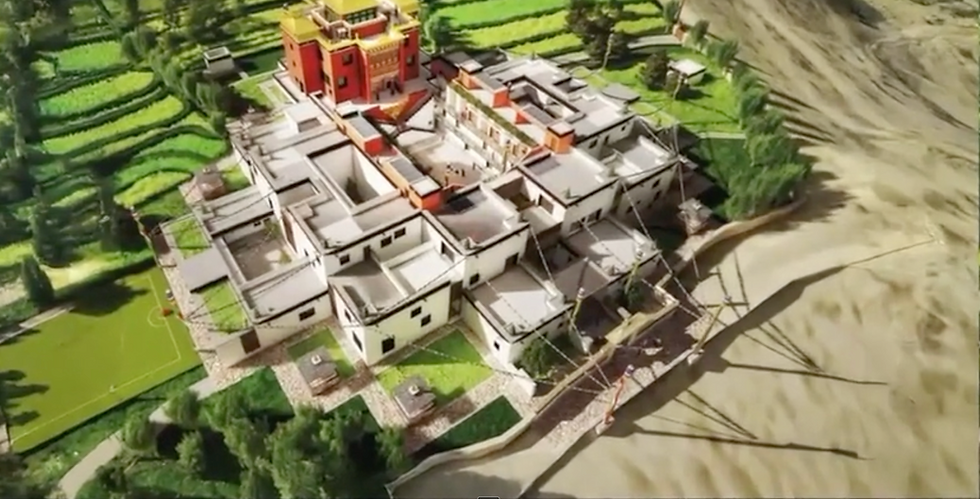
The monastery looks over the surrounding hills and the Himalayan range beyond. It does not "dissolve" into them like the Massey design.
Added: the AI notion of the Maxey design "dissolving" into the hills strikes me as not quite obvious, but as a non-expert, I leave it undisputed. You can judge yourself.
Brown disagreed with this direction and severed his relationship with the foundation. At least, this was the Geshes' explanation to me. Dan Brown saw it the other way round.
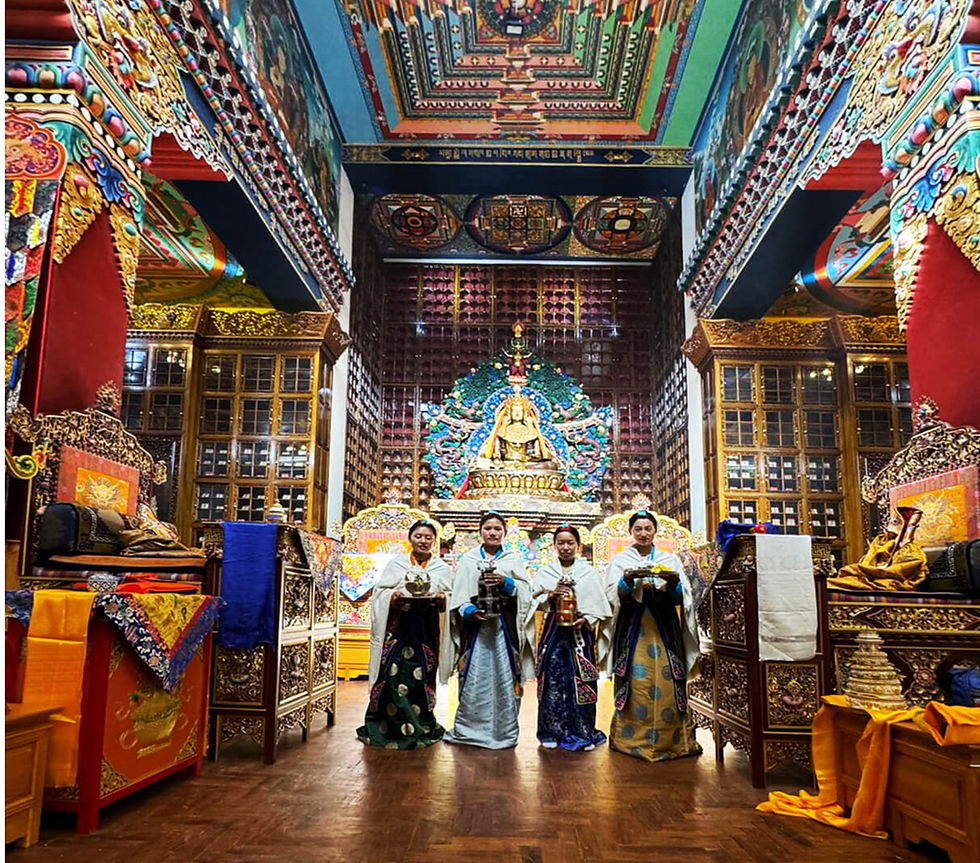
Phase 1 of the Shenten Thagye Ling Monastery — whose name translates as "the center on the edge of the frontier of Tibet from which the teachings of Buddha Tonpa Shenrab will spread and expand" opened in 2024.
Books and videos: the Arche Noah project to save a culture
The same tension between tradition and modernity had already shown up during the translation work. In this case, though, it did not show up as a conflict between Dan and the Geshe: they were a united team.
In December 2013, Brown and Geshe Sonam Gurung stood before H.H. the 33rd Menri Trizin, lineage holder of the Bon teachings, who placed before them the collected works of the great yogi Shardza Tashi Gyaltsen. His mandate carried three conditions: translate accurately, embody the practices personally, and render them in a form that works for Westerners. Three conditions, each pulling in a slightly different direction.
On the current website of the Mustang Bon Foundation, the completed books are presented as follows:

Brown brought to this work the knowledge of a Harvard psychologist whose own meditation and meditation teaching s strongly influenced by meeting the Bon tradition and the pointing out style of teaching. The resulting translations are functional and accessible, shaped by the conviction that these texts needed to be understood by Western minds, not just by classical Buddhist experts. These are sx of the eight books.

Self-Arising 
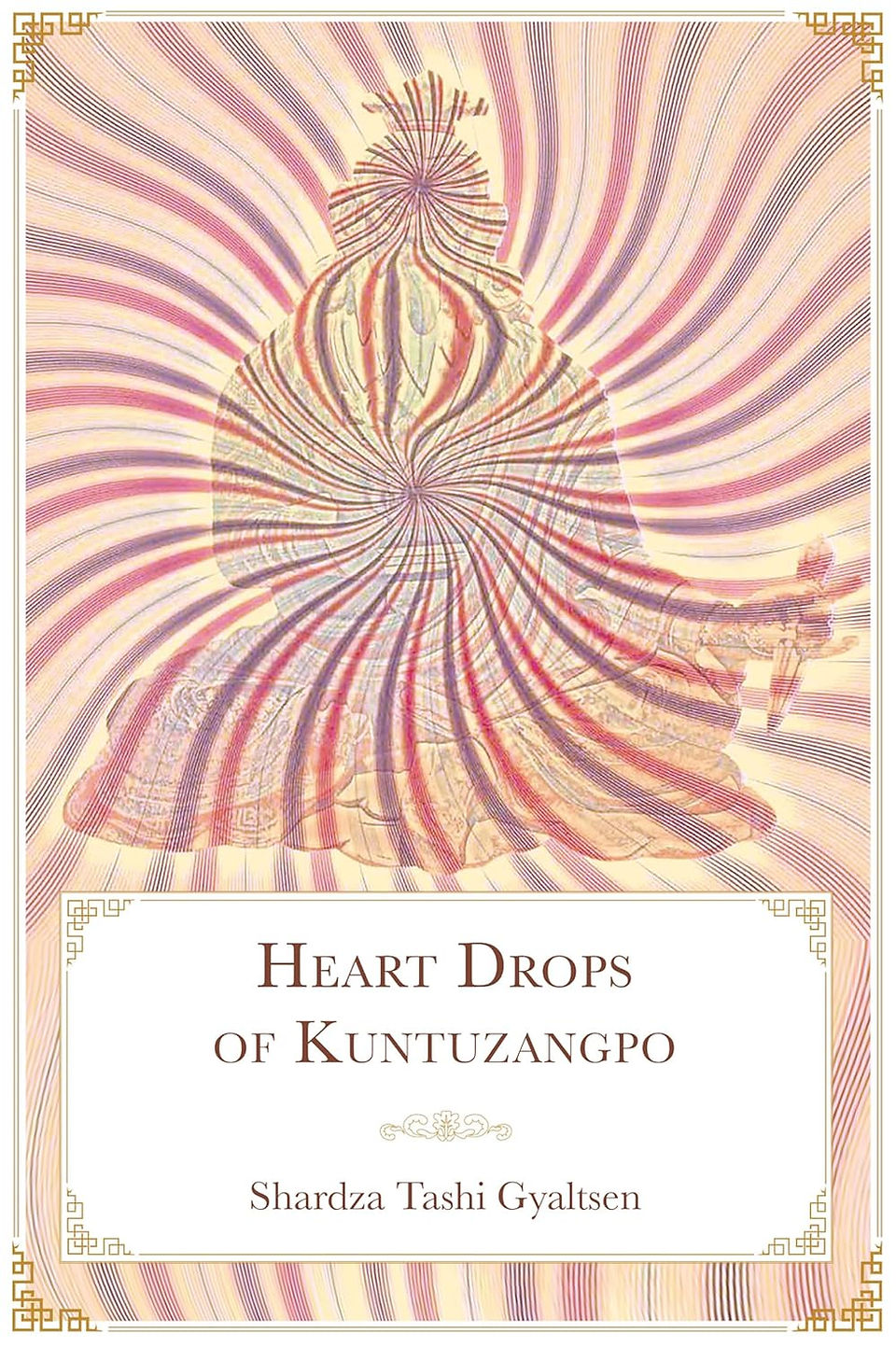

A book cover 
A Book Cover Foto 
As first translation, they translated a full version of A Khrid, which turned out to guide Dan Brown´s design of his later meditation system
A Khrid
This book is currently no longer available on Amazon, neither has hardcover nor as Kindle. However, some years ago, with limited knowledge and little writing experience, I wrote a structured summary on my blog

Daniel P Brown framed the entire project against a specific historical catastrophe: during the Chinese invasion of Tibet, approximately 100,000 volumes on states of mind were destroyed in a single week.
For Brown, the translations were lifeboats from a burning library, and every accommodation made for Western readers was a price worth paying to keep the cargo alive.
The videos: backup to the books
Beyond the printed texts, he envisioned a multimedia archive: professionally produced films documenting advanced yogic exercises, recordings of tummo practice, audio-visual materials capturing technical details that written language alone cannot convey. The video, he said, also included actual couples performing the tantric exercises.
we have a complete videotape recording of all the unified practices from beginning to end ...including the consort practices the unified practice you do with the sexual consort . There are probably six people on the planet or knowing I'll do these things in the monastic tradition they're all going to die out
The interview starts where he talks about the videos.
I have no information what happened to the videos, except that the lawsuit between Dan Brown and MindOnly resulted in a return of all videos to Dan Brown´s estate.
Mundane language: perhaps a provocation to some
Coming back to the translations: some passages in the translations are indeed conspicuously contemporary in register. The language is at times very colloquial. I have only seen a few comparisons between the translations, and I admit Dan's translation is quite distinctly Western at times.
"With respect to the lotus, the outer signs are that the body is not too big or too tall, not is it too short, she is so beautiful to your eyes, her forehead is elevated and has three wrinkles going up, the skin of her upper and lower limbs are lush, (her body) has a sweet smell, the way she walks is sexy, she doesn´t get too old too fast, she has long curved eyebrows, and her vagina is tight. The inner signs are: her clitoris is long, and the (vaginal) passageway is shaped like a lotus flower, her (vaginal) passageway is easy to find, it is easy to open, and because of that she is the best female consort. The secret signs are that (when you see her) she blows your mind by her beauty, she has expertise as a female consort of bliss, and likewise in sucking the penis, and she has deep trust, admiration of virtue, and admiration of special conduct. This is completion empowerment. She is the action-seal (karmamudra) of fulfillment" (Threefold Enlightenment, p. 586)
Professional Tibetan translators have criticised the result, attributing it solely to Daniel P Brown, never to the Geshe as a collaborator. Documented criticism eg on Reddit includes grammatical errors, failure to recognise common idioms and poetic structures, misunderstanding of central philosophical terms, passages rendered without coherence, errors on nearly every page, and the use of a rather pictorial language as in the example above.
The summary charge is that insufficient linguistic and philosophical grounding produced translations that are too often misleading.
The criticism leaves unaddressed the role of Geshe Sonam Gurung, a highly trained Tibetan scholar-monk who co-translated every volume.
They also ignore that Dan Brown may have made very conscious choices, having done his own extremely faithful translation of "Moonbeams of Mahamudra" for his 1981 dissertation.
This AI video gives a high level overview of one of the aspects of translating from Tibetan
There, he gave very clear explanations for the difficulties of translating the meditation language of Tibetan to English.
Making peace
In a 2025 interview, the Geshe´s assessment is entirely positive and without any trace of conflict.
He says:
"We translate five six book and that those are the very essence of our born ancient teaching in Himalaya teaching how they really heal themself and the spiritual way. So those been translated and now with me and we go really deep in with the experience."
He frames the collaboration with Brown as a natural and productive phase in bringing the teachings west, something that served its purpose. He also credits Brown as part of the chain that connected him to the Western sangha: "we met the Mustang bon foundation like through Dr. Dan Brown and then we work together we teach in west we translate the books."
There is no criticism, no mention of disagreement, and no reference to the architectural or institutional conflict. The overall tone suggests he has simply moved on. His attention is entirely on the monastery, the children, and the continuation of the lineage. The split, from his side at least in this public context, is treated as history that requires no comment.
The translations as vehicles in practice
Brown's answer is that Menri Trizin himself asked for this. The mandate was not a scholarly edition but a living "practice manual". Or, the way I see it, a documentation of past practices.
My personal view, having read and reread the 8 volumes: I would never have been able to muster the energy and time, if only the more "faithful" legacy renderings had been available. I would never have met this amazing cultural tradition so closely. And, I never intended to use these volumes for actual practice, something each book warns against anyway.
Similarly, reviewers on Amazon praise them for accessibility.
For this one writing, not comparable to anything else in existence like being whispered to by the Dalai Lama about the secret yoga practices of Tibet, but in English, with no secrets.
it is hard to find similar book to the Self-Fold embodiment of Enlightenment. If we compare this book against classical works on Mahamudra. Mahamudra books lack 90% content what this book offer. And inside the dzogchen literature this book is one of most complete pointing out the stages and paths within dzogchen. I am personally awe struck from this book. This will be our tradition main book on meditation.
The material history of the texts
The material history of the texts mirrors the institutional rupture. Initially published by Bright Alliance with copyright held by the Pointing Out the Great Way Foundation, the rights passed to the Mustang Bon Foundation against Dan´s preference, which now explicitly directs all profits to the Mustang Cultural and Education Centre in Nepal, rather than to individuals or a company.
The foundation also did not forget to mention on their website that Dan personally received nearly a million USD for his translations. I find this a bit over the top. Yes he did, but this was to compensate for the loss of income over many years from his previous employment at the university. Dan did not aim to become rich per se, and eventually didn´t - unlike many of the "spiritual luminaries" in the West, Eckart Tolle, Spira, etc.
Early editions, which I bought in a spending spree, carried both translators' names on the cover, with Dan modestly taking second place after the Geshe.- Later editions show only the original author, Shardza Tashi Gyaltsen. The "Precious Treasury" now also shows a less abstract representation of the original author.

The translators remain inside, on the title page, but the face the book shows the world now belongs entirely to the source tradition.


The thing I needed was to print unique bingo cards in bulk without paying per card. Did 75. Took longer to load the printer than to make them.
The thing I needed was to print unique bingo cards in bulk without paying per card. Did 75. Took longer to load the printer than to make them.