
The Secret Books: Do not put yourself at risk. Daniel P Brown´s Marshmallow Test for spiritual readers.
Updated: Jul 30

(the 7 minute AI video version is here)
TLDR: this post discusses the dilemmas / contradictions of trying to keep Buddhist teachings secret, while simultaneously publishing them as books on Amazon and restricting access to live teaching. It also shortly presents different approaches.
The warnings: famine, leprosy, and financial ruin
There´s a brilliant meditation teaching system. The most sophisticated one can imagine, pulling together Tibetan Buddhism, Bon, neuroscience, attachment and trauma theory, hypnosis, and utterly refine pointing out instructions, tested over 20 years of retreats.
The system
teaches the Elephant Path - normally months - in 2.5 days,
gives access to glimpses of awareness seeing itself in 7 days for 30% of retreat participants (Dan Brown´s own stats)
is accesssible only to a few people because its guardians keep the lid on it.
In Tibet, this would have been normal and expected: the teachings were given only from teacher to student, under the threat of punishment if you broke "the seal". In texts like A Khrid, a thousand year old condensed teaching system, you see instructions like this:
Warning (ad 1275)
Do not promulgate these teachings in an ordinary way, nor corrupt them even in the slightest way
Available for 75 euro

This is a more severe warning from Shardza´s "Precious Treasury":
Those tantric yogis who don't have the initiation gift-waves will become mute, get leprosy, become crazy, contract diseases and get famine, and get into conflicts with others.
Shardza also gives a warning to not widely share the teachings in "Self-Arising.." :
Even for those individuals who have a fortunate karmic connection, don't spread it to disseminate [the teachings] to more than three or four [such students], or it will incur the punishment of the däkimis.
But, the mass publication on Amazon is exactly this "promulgation in an ordinary way" (I do not judge it here, to the contrary, I am just showing the contradiction).
Later, the warnings given by Dan Brown´s Pointing Out the Great Way foundation would include severe financial penalties for unauthorised copyright violation (the modern equivalent of yogi´s secrecy).
Releasing the secrets to the Western book market
And then a Tibetan lineage holder decides that they should be translated and released. Menri Trizin believed that the “rapidly dwindling number of cave and hermitage yogis” created a risk that these advanced practices could be lost.
He asked Dan Brown and Geshe Sonam Gurung to translate in a way accessible to "Westerners" for reading and use. As supporting activity, he also asked Dan Brown to practice himself in this way. Dan did this, with exception of a few practices (eg rainbow body, consciousness transference to a corpse).
This is an AI generated video on the translation topic (7 minute)
A few years later the secret books are on Amazon, and some circle as bootlegged copies (as nearly everything digital). Everything is out in the open. What now?
The current dilemma: to read or not to read?
Now, there are
the books with formerly top secret knowledge, the reading of which may lead to conceptual hardening, even if one keeps away of the obviously dangerous practices
the teachers: very few (between 5 and 10?) teachers authorised in some form to teach in that specific method that does not lead to conceptual hardening
the retreats: a few live and online retreats (that are worth the money! but expensive for many
This poses a strange challenge: if I can´t attend a live retreat, on premise or online,
should I buy the books regardless, and thereby risk conceptual hardening?
should I read them only in a specific way - eg not follow any practices described in them? But isn´t reading already a form of practice in the mind?
should I wait with buying or reading them until I can book a retreat to be guided to the knowledge in the right way, but thereby missing out for years, perhaps?
It´s like a kind of "spiritual marshmallow test": if I consume them now, I get something but am conceptually hardened. If I wait until having had the retreat, I will be rewarded with more and deeper insight.
Spiritual risk: Conceptual hardening
Note: this chapter is related to another post with some overlapping content.
Daniel P Brown, the translator of these books, gave one overriding reason for keeping the teachings undercover. He called it "conceptual hardening".
Dustin diPerna is a long-time student and co-teacher, highly appreciated as a teacher by Dan Brown according to retreat participants. He now teaches under his own label "Rigdzin". It carries forward many of the approaches of "Pointing Out the Great Way", adapting them along the way. This is natural, as each teacher is different, and "Pointing Out the Great Way" was probably tightly bound to the unique personality and extremely broad scope of Dan´s background as therapist, coach, meditation teacher, translator and familiarity with many of the known Tibetan teachers including the Dalai Lama.
But Dustin carries forward the warnings against "conceptual hardening". For Dustin´s new (as of 2026) book, he put up this warning on Amazon :
This book is a restricted text intended for students who have completed a Rigdzin introductory retreat. If you have not attended a full retreat please do so before reading this book. Exposure to some of these ideas before a direct introduction in meditation can harden the mind with conceptualization and make the realizations more difficult to recognize. Please protect these precious teachings so that others can benefit directly.
Note: "restricted" isn´t quite obvious when sold for 17 Euro on Amazon. But, this is a soft warning, appealing to the self-interest of the reader, it´s just missing an explanation of the concept of conceptual hardening.
However, the warning "protect these previous teachings so that others can benefit directly" is not quite clear to me.
Should I not give it as present to others?
Having read it, not talk about it?
Conceptual hardening occurs when the meditation student "knows too much", then thinks too much, and cannot fluidly follow the pointing out instructions given in a real live teaching, as he is prooccuped with comparisons, criticism and other mental events. It is destructive for "pliancy" of the mind, a precondition for the style of complex insight teaching by Dan Brown.
This video gives a short overview of the concept of conceptual hardening (AI generated)
My personal view:
I may not subscribe to all practical implications, but I can follow this argument.
Retrospectively, I am glad that I didn´t know anything about the essence traditions (Mahamudra, Dzogchen) when I attended Daniel P Brown´s Level 1 retreat based on a coincidence, not because I was "a seeker".
It was extremely impressive, as it would not have been if I had come with my usual, nagging "know it all" attitude - conceptually hardened.
Obviously, there may also be other considerations at play: creator pride, financial considerations etc. But I will leave these aside as main motivators in this case.
Physical and psychological risks: extreme yogi practices
But now, the cat is out of the bag and everyone with 39-100 USD can read the "secret" teachings translated by Dan Brown. The translations still contain a rather ominous warning, added by the editor. They are not part of the body of translated text, and they have the same standard wording for all translations.
Warning (ad 2019)
These advanced practices should only be practiced after getting the appropriate transmissions, and done only by practitioners with appropriate qualifications, permissions, and pith instructions. Without such qualifications, permissions and instructions, these practices can be dangerous, so do not put yourself at risk
Available for 60 euro (Kindle)

Thus, for 60 euro you can chose to "put yourself at risk". I know it´s well meant, and perhaps a reminiscence of the tradition. But seriously: what does it mean today? And what is "practice"?
In fact, the warning may be justified assuming that someone were to literally follow them. After all, the exercises were meant for hardened and experienced yogis, not for school moms.
At first glance, the warnings seem simply uninformed by today´s standard. For example, here are warnings for the breath exercises ("wind")
Wind Reversal / Tsa-lung (Channels & Winds) The explicit text warns that doing this wrong causes brain pain, spinning, mutism, insanity, paralysis, and organ disease. The five winds each have specific failure modes: wrong practice with the life-force wind causes the wind to "enter the heart" leading to rage, memory loss, or madness; wrong practice with the all-pervasive wind causes limb paralysis; wrong practice with the downward wind causes cancer/kidney disease.
These warnings actually correspond to real risks in current Western medicine and psychology. For example, "rage and insanity" are expressions for the phenomenology of today´s Holotropic Breathwork.
Here is a hopefully entertaining video overview some risks.
A reality assessment; the actual risk is largely hypothetical because extremely few lay people will attempt 49 day dark retreats, unsterilised penis insertion of objects, or consciousness transfer to a corpse!
And here are some more risks which may be real if one naively follows the instructions for hard-core yogis:
Carotid artery pressing → risk of unconsciousness
Manual eyeball pressure (foundational vision technique)
Sun gazing → risk of eye damage
Falling posture (standing → falling backward) → head/neck/spinal injury risk
Here is a mapping of the general terms Tibetan terms against modern terminology:

Safety rails: the actual pointing out instructions are still undisclosed and copyright-protected
So, there are many publications. What is left protected? As of 2026, the problem of "conceptual hardening" risk has deepened through yet another publication: the 3 volumes of "Cloudless Mind", a series of transcriptions of live events with Dan Brown.
Based on this book, many of the previously scattered pieces of information about Dan´s thinking are assembled in 1000 pages for a modest price.
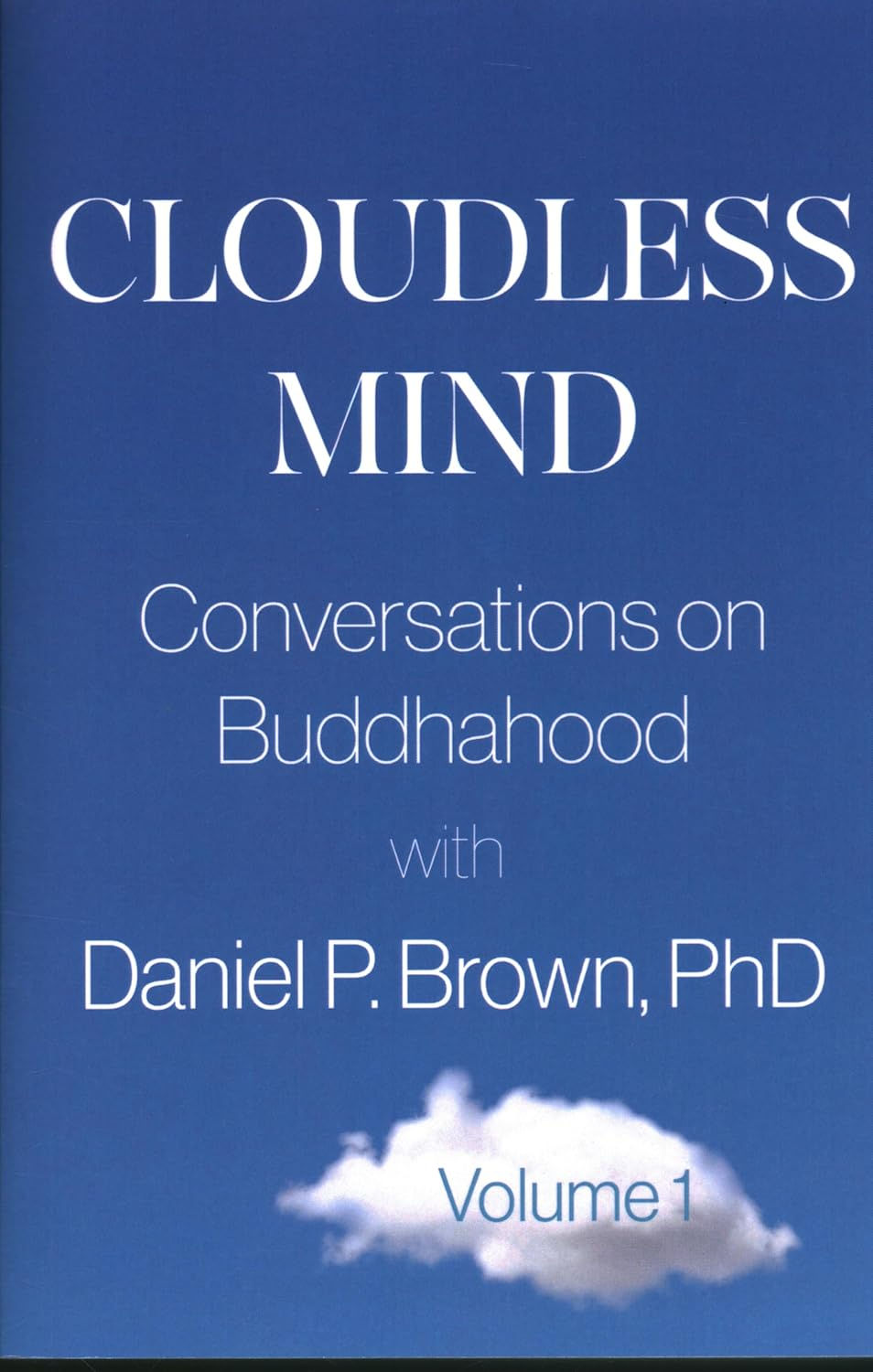
Cloudless Mind
"Every Wednesday Night, for over six years, Dan Brown answered questions by students and colleagues about positive and negative experiences in life and mind, integrating the perspectives of both Western psychology and Eastern traditions of spiritual practice -- most notably Vajrayana Buddhism, Dzogchen, and then the Bon tradition" (Amazon)
Available for 22 euro per volume
Until "Cloudless Mind", there were a few channels through which one could reconstruct some of the method and thinking behind it:
Retreats - The live and online retreats - but attendees were not allowed to record them, and were discouraged to share, so it´s mostly manual notes and recollections.
Mini-sessions, live and later also online, called "Living Meditations" when I joined them in 2021, shortly before his death. These were published as transcripts in 2025.
Youtube appearances on podcasts, that had been initiated by his then commercial partner who wanted to give Dan broader traction for a joint publication project ("Mind Only")
The Concentration Training course on Mind Only which is now not commercially available
The "Elephant Path" book containing writings by Dan on concentration training in general
But there is one limitation: WIth the exception of the no longer commercially available Mind-Only "Concentration Training" course, none of these reveals the real core of the method, where the rubber meets the road:
The detailed and precise "hypnotic" pointing out instructions given in the retreats .
They are selectively accessible to retreat participants, or through unauthorised sharing of recorded retreats, as Dan Brown was disappointed to note already before 2010.
I have been amazed at the number of students who have come forth and have disclosed the ‘creative’ ways they are using this course material in different contexts. I didn’t expect these precious teachings to invite a feeding frenzy. No student is authorized to use this material in any way, other than to guide personal meditation practice, without written consent from me.
For that reason, students had to accept the Guidelines for Students. Very few meditation texts are accessible as fragments he used in late public appearances (eg the wide ranging Sacred Sundays interview on Youtube)
His “Guidelines for Students” document for the retreats is legally and ethically clear: students were not authorized to teach, distribute, or even transcribe materials without explicit written permission from Daniel P. Brown. These included:
Copyright restrictions on all teaching material
Prohibition on distribution outside same-retreat groups
Absolute confidentiality around student experiences and retreat content
Limitations even on recordings and transcriptions
A strong emphasis on teacher-student relationship as an essential safeguard
What he could protect, was the "organisation and languaging" of the teachings. And his organisation threatened with what can only be called financial annihilation for using them outside of private study use.
Copyright law knows this differentiation:
Concepts and trademarks
This is not the case for concepts, which cannot be copyright-protected. For example, Dan´s descriptions of the 3 Maps. Or, the hypnotic concepts behind his pointing out instructions which I recognised during the retreat.
The question is of course: does this kind of analytic use of the material create more risk of conceptual hardening than the already published books, in particular now "Cloudless Mind"? In this reflection, I was also guided by the stated intention of "Pointing Out the Great Way" after Dan´s death on the POGW website to publish Dan´s contributions. As of April 2026 it shows_:

But, this has not happened since 2022 - I assume that "Cloudless Mind" is fulfilling this promise to a degree. and that is fine, as opens up Dan´s thinking widely.
So, I think that by now the legacy estate of Dan Brown has accepted a certain degree of "conceptual hardening" risk as the price to pay for sharing Dan´s thinking more widely.
Specific expressions are copyright automatically
Under the provision of the Fair Use act, specific meditation instructions are automatically protected. The Fair Use act, however, does not prohibit ANY use, as long as it conforms with the act.
To honor Pointing Out the Great Way and to follow the law, I have therefore been very careful to only quote direct meditation instructions (for illustration, not for teaching) that are or were already out in the public - e.g. through his wide-ranging Sacred Sundays interviews where he shared some snippets, or through Vimeo-published recordings.
Khenchen Thrangu and the use of books for unsupervised self-study
And then there is Khenchen Thrangu, who opts more for a democratised "home study" approach, as opposed to "the experience of dramatic instantaneous pointing out" that I had in fact experienced in Dan Brown´s retreat.
The following text is quoted by Peter Barth in his book on Mahamudra exercises, available for 5 dollars on Amazon.
“In short, I think it is of far more importance that people receive this kind of complete and systematic instruction so that they can gradually develop experience on their own, than that some kind of dramatic pointing-out procedure be done.
Of course, it is possible to give dramatic pointing-out instruction, and when you do so, some people do recognize their mind’s nature. But, if I may say so, I question the stability and, therefore, ultimately the value of that. It certainly is a dramatic experience for those people who achieve it, but I see no evidence of their kleshas diminishing as a result.
And furthermore, they then carry away with them the arrogance of the thought, “I have seen my mind’s nature.” I think it is of far greater importance actually to practice meditation slowly and surely and make all possible use of the resources which this book, in particular, gives you."
I think that it is of far greater importance than the experience of dramatic instantaneous pointing out that people be taught Mahamudra as a full system of instruction that they can implement on their own gradually through diligent application using either one of the three texts by the Ninth Gyalwang Karmapa—The Ocean of Definitive Meaning, Dispelling the Darkness of Ignorance, or Pointing Out the Dharmakaya— or one of the texts by Dakpo Tashi Namgyal—either Moonbeams of Mahamudra or The Clarification of the Natural State."
Thrangu, K. (2011). The Ninth Karmapa’s Ocean of Definitive Meaning
Khenchen Thrangu is in line with Dan Brown on many points perhaps except on the use books for self-study.
"Using books" to develop themselves: Brown likely viewed this as a fundamental mistake for Westerners. In his view, and perhaps rightly, without a teacher, and personal feedback on learning status and without error correction, one just develops bad habits and uncorrected conceptualisations. For Dan Brown´s Pointing Out the Great Way approach, the teacher is the method "dictator".
Sharing everything freely: Jackson Peterson and his Facebook Pointing Out Method Scattergun approach
So this leaves an interesting problem, where the attempt to protect students from "conceptual hardening", keeping a proprietary method secret through modern copyright, and the traditional intent on spreading the teachings freely "for the benefit of all sentient beings" clash with the realities of modern book production and digitisation and increasingly AI.
Here is a counter-example: Jackson Peterson , who freely and generously shares the pointing out instructions he received
as hundreds of Facebook posts, with the hope of giving as many readers as possible some deep insights or sudden recogition event. He explains his goals here.
His "method" is not really structured, step by step, permission based, and refined like Dan Brown´s , but he refuses that it has to be so difficult and elusive.
Dan Brown set up an elaborate scaffolding with his method- and system-guided approach, based solely on Mahamudra and Dzogchen traditions. This was combined with Western development theory, neuroscience, hypnotherapy, attachment thery and trauma theory. Other than may other teachers, Dan Brown avoided topics in which he would have no expertise like quantum physics etc.
Jackson Peterson is eclectic and pulls together strands from Mahamudra, Sufi, Zen and other traditions, supported now in his thinking and writing by AI (Grok, Gemini, ChatGPT). In addition, he eclecticalöly uses current scientific concepts like predictive processing, quantum theory, the block universe, neuroscience (in particular the Default Mode Network) and others.
Three models in comparison
Daniel P Brown: transmission at the right stage, practice is sequenced and prerequisite-gated, stages are explicit and verifiable, relational container matters, method is secret. I know it "works". Dan Brown used to claim a rate of 30% of Level 1 participants having had a "a glimpse" , however unstable, after 7 or 8 days. This is believable according to participants.Whether the massive financial damages threatened for unauthorised publication is justifiable? There has always been criticism around this aspect.
Jackson Peterson: "open source" free transmission on FB is the mechanism, repetition is the method, no practice required, no developmental map, nothing held back - I am a bit sceptical but honor the intent and generosity. It´s deplorable that there are no stats.
Thrangu Rinpoche: transmission, combined with self-study and autonomous learning via book, no reliance on only "dramatic pointing out instructions".
Maybe the Thrangu model is right, and I think there is an initiative working on setting up a more "open source" model.
Confusion
At the moment, I can only conclude that there is a pretty confused situation regarding "secrecy".
For students | For teachers | For the tradition |
|
|
|
References
Daniel P Brown, "Cloudless Mind"
Daniel P Brown, "Elephant Path"
Dustin diPerna: "Lamps of Wisdom"
Khenchen Thrangu, "Ocean of Definitve Meaning"
On Facebook: Jackson Peterson - and he is currently writing a new book
See detail collected book references here And my post on Dan Brown´s "hypnotically refined" language https://www.till-gebel.com/post/dzogchen-meditation-hypnosis-daniel-p-brown


Hid a proposal in a cryptogram and left it on the kitchen table. She solved it in about twenty minutes, which was twenty minutes of me pacing in the hallway.